
How to Use ChatGPT for Marketing: 7 Practical Ways
Marketing a business takes time. You need to create content, write emails, manage social media, research your audience, and find ways to attract potential customers. For small businesses and solo entrepreneurs, handling all these tasks can quickly become overwhelming.
This is where ChatGPT can help.
ChatGPT is an AI assistant that can help marketers brainstorm ideas, prepare content drafts, organize campaigns, and improve everyday workflows. Instead of starting every task from scratch, you can use it to develop ideas and create a useful first draft in less time.
However, getting good results requires more than entering a short instruction and copying the response. You need to provide context, understand your audience, and review the output before publishing it.
In this guide, you will learn how to use ChatGPT for marketing, explore practical examples, and discover prompts you can adapt to your business.

What Can ChatGPT Do for Marketing?
ChatGPT can support several marketing activities, including content planning, social media management, email writing, SEO brainstorming, advertising copy, and customer research.
For example, a small online store could use ChatGPT to brainstorm product content ideas, draft a promotional email, and prepare social media captions for an upcoming sale.
The main advantage is flexibility. You can ask follow-up questions, request different versions, and adjust the output to match your brand voice.
ChatGPT should be treated as a marketing assistant rather than a replacement for human judgment. It may produce inaccurate information or generic suggestions, so important claims and recommendations should always be checked.
1. Use ChatGPT to Generate Marketing Content Ideas
Coming up with fresh content ideas can be difficult, especially when you need to publish regularly. ChatGPT can help you identify potential topics based on your business, audience, and marketing goals.
Suppose you run a software company that sells project management tools. You could ask ChatGPT to suggest blog topics for freelancers, small business owners, and remote teams.
It might suggest beginner tutorials, software comparisons, productivity guides, and explanations of common workflow problems. You can then choose the topics most relevant to your audience.
Example prompt:
“Act as a content strategist for a small SaaS company. Our target audience is freelancers and small business owners in the United States. Suggest 15 useful blog post ideas about project management software. Organize them by search intent and explain what question each article should answer.”
Use the results as a starting point, not a finished content strategy. Check search demand, competing pages, and your audience’s actual needs before investing time in an article.
2. Create Social Media Posts More Efficiently
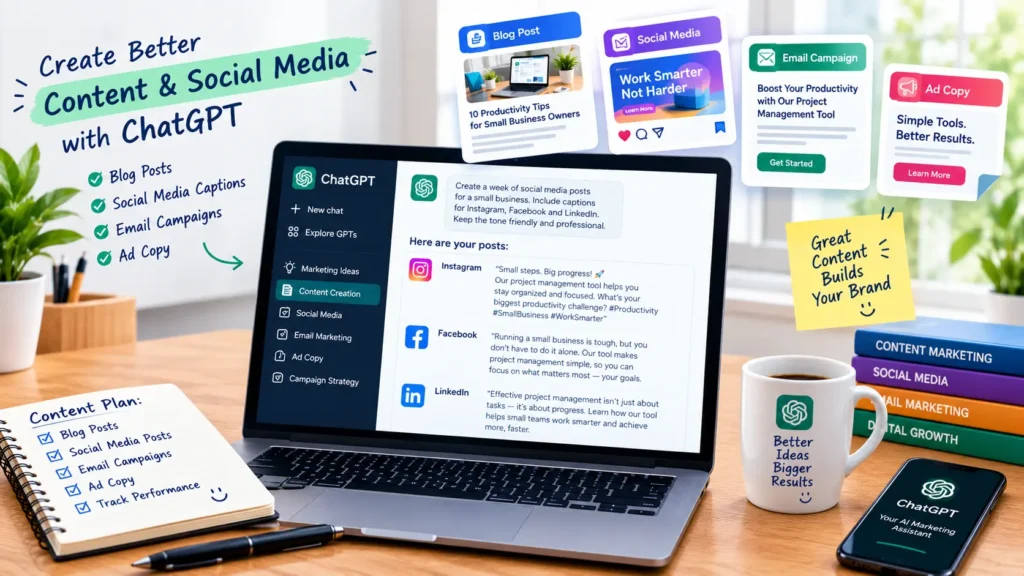
Social media marketing often requires multiple versions of the same message. A product launch, for instance, might need a Facebook post, a LinkedIn update, and several short promotional captions.
ChatGPT can help adapt one core message to different platforms. You can specify the audience, desired tone, length, and purpose of each post.
For a SaaS business, a single product feature could become an educational LinkedIn post, a short Facebook update, and a question designed to encourage discussion.
Example prompt:
“Create three social media posts introducing our new project management tool to small business owners. Write one professional LinkedIn post, one friendly Facebook post, and one short promotional caption. Focus on the problem the product solves. Avoid exaggerated claims and leave space for a call to action.”
Before publishing, confirm that every product feature and benefit is accurate. Add original insights, relevant visuals, and a clear message rather than posting generic AI-generated content.
3. Improve Your SEO Content Workflow

Search engine optimization involves understanding what people are searching for and creating pages that answer their questions. ChatGPT can assist with brainstorming keywords, planning article outlines, and identifying related questions.
For example, if your main topic is email marketing software, you might ask for supporting topics such as email automation, subscriber management, campaign reporting, and beginner setup guides.
You can also use ChatGPT to draft SEO titles, meta descriptions, FAQs, and internal linking suggestions.
Example prompt:
“I am planning an informational article about email marketing tools for beginners. Suggest relevant long-tail keyword ideas, explain the likely search intent behind each, and create a useful article outline. Do not invent search volumes or keyword difficulty scores. Identify which details need to be checked using an SEO research tool.”
This distinction matters because ChatGPT-generated keyword ideas are not verified keyword data. Use tools such as Google Keyword Planner or a dedicated SEO platform to investigate search demand and competition.
Your final article should offer meaningful information, examples, and original value. Adding a keyword repeatedly will not automatically improve rankings.
4. Write Better Marketing Emails
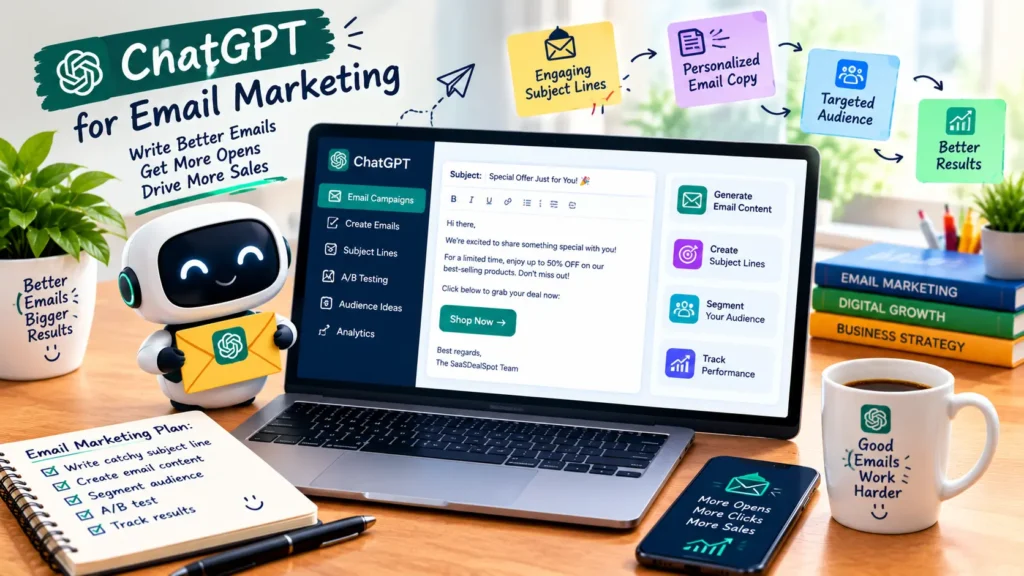
Email remains useful for welcoming subscribers, announcing new features, sharing educational resources, and reconnecting with customers.
ChatGPT can help you create an initial draft for these messages. You can also request alternative subject lines or adapt an email for different audience segments.
Imagine a SaaS company introducing a new reporting feature. The email could explain the problem it solves, show how the feature works, and invite users to explore it.
Example prompt:
“Write a welcome email for people who subscribed to our SaaS product newsletter. The audience consists of small business owners. Use a friendly, professional tone, explain what subscribers can expect, and include one clear call to action. Do not invent discounts or product features.”
Review every email before sending it. Check the offer, destination links, pricing, and claims. Also follow applicable email marketing and privacy requirements, and avoid sending unsolicited promotional messages.
5. Develop More Effective Advertising Copy

Writing advertisements requires communicating a product’s value quickly. ChatGPT can help generate alternative headlines, descriptions, and calls to action for campaigns on platforms such as Facebook, Instagram, and Google Ads.
Rather than asking for a single advertisement, request several variations that emphasize different customer needs.
For example, a productivity app could test messaging focused on saving time, organizing tasks, or simplifying team collaboration.
Example prompt:
“Create five advertising headline variations for a productivity app designed for small business owners. Give each headline a different angle: saving time, improving organization, team collaboration, simplicity, and ease of getting started. Keep the claims realistic and avoid promising guaranteed results.”
Use these variations as hypotheses for testing, not proof that a particular advertisement will perform well. Actual results depend on the audience, offer, creative, landing page, budget, and campaign settings.
Make sure the final copy complies with the advertising platform’s policies and accurately represents the product.
6. Research Your Audience and Understand Customer Problems
Successful marketing begins with understanding the people you want to reach. ChatGPT can help organize information from customer interviews, product reviews, survey responses, and support conversations that you are authorized to use.
For example, if customers frequently mention that a software tool is difficult to set up, you could use ChatGPT to group feedback into themes and identify possible improvements to your onboarding content.
Example prompt:
“Analyze the customer feedback below and group the comments into recurring themes. Identify common frustrations, desired outcomes, and unanswered questions. Separate direct evidence from your interpretations, and do not invent customer opinions.”
The quality of the output depends on the quality of the information provided. AI-generated personas or assumptions should not be treated as verified customer research.
Protect personal and confidential information when using AI tools. Whenever possible, remove identifying details before submitting customer feedback for analysis.
7. Build a More Organized Marketing Plan
A marketing plan helps connect individual activities to a larger goal. ChatGPT can help turn your initial ideas into a draft schedule with tasks, deadlines, and performance indicators.
For example, a small SaaS company preparing to launch a new feature might need blog content, social posts, an email announcement, and a product landing page.
ChatGPT can help organize these activities into a practical sequence and suggest metrics to monitor.
Example prompt:
“Create a four-week marketing action plan for a small SaaS company launching a new feature. Include content preparation, email communication, social media promotion, and performance review. Organize the plan by week and suggest measurable indicators. Clearly label assumptions that require business-specific data.”
Before adopting the plan, check your available budget, staff capacity, launch date, and previous campaign results. An AI-generated schedule may look complete without being realistic for your business.
Use the plan as a working document and update it as real performance data becomes available.
Tips for Getting Better Results From ChatGPT
The instructions you provide have a significant influence on the usefulness of the response. These practices can help you get more relevant marketing output.
Give it business context. Explain what your business offers, who your audience is, and what you want to achieve.
Describe the task clearly. Instead of asking for marketing ideas, specify whether you need blog topics, email copy, an advertising concept, or a content calendar.
Set the format and tone. Tell ChatGPT whether you want a table, checklist, short caption, or detailed article. Describe the tone you want it to use.
Ask for alternatives. Request several approaches and compare them against your audience and business goals.
Verify important details. Check product specifications, statistics, legal claims, current pricing, and other facts against reliable sources.
Add your own perspective. Incorporate real customer questions, product experience, relevant examples, and insights that competing pages may not offer.
Most importantly, do not publish every AI-generated response without reviewing it. Marketing content should be accurate, useful, and consistent with your brand.
Common Mistakes to Avoid
One common mistake is giving ChatGPT vague instructions. A request such as “write a marketing post” does not explain the audience, platform, product, or intended result.
Another mistake is assuming that a polished response is necessarily correct. AI can produce convincing statements that are inaccurate, outdated, or unsupported.
Businesses should also avoid publishing large amounts of repetitive, low-value content simply to increase article count. Search visibility depends on many factors, and using AI does not guarantee rankings.
Finally, do not rely on AI alone to make important decisions about positioning, budgets, customer relationships, or campaign performance. Use it to support your thinking while relying on evidence and business judgment for final decisions.
Final Thoughts
Learning how to use ChatGPT for marketing can help small businesses and solo entrepreneurs approach everyday marketing tasks more efficiently. From generating content ideas and drafting emails to preparing advertising variations and organizing campaigns, the tool can provide a useful starting point for many workflows.
The best results come from combining clear instructions with accurate business information and thoughtful review. Start with one repetitive task, test how well ChatGPT supports it, and improve your process based on the results.
You do not need to automate every part of your marketing at once. Choose the task that consumes the most time, use ChatGPT to create a first draft, and apply your own expertise before putting the result in front of customers.
That approach allows you to benefit from AI while keeping your marketing relevant, trustworthy, and focused on real customer needs.